
Running a Sex Offender Check in Armstrong County
The Texas Public Sex Offender Registry is the main public channel for Armstrong County. Texas DPS maintains the central database from registration information supplied by local criminal-justice agencies, TDCJ, and the Texas Juvenile Justice Department. An ordinary public search is free and needs no account. Search by Armstrong County for broad local coverage, by address for a precise area, or by name when a person is already known.
The Armstrong County Sheriff is the documented local fallback. State law assigns registration to a municipal law-enforcement authority for a person who lives inside a municipality and to the county authority outside one. Claude publishes no police department or registration desk. Call the sheriff at (806) 553-6933 to confirm the authority designated for a Claude address or to ask about a record whose verification agency is the sheriff. No local registry interface, fee, special hours, or appointment rule is published.
Use Armstrong County Registry Filters
A city query is not the same as a county check. Armstrong County includes rural homes whose residents may register with the sheriff rather than a city authority. Open the official county search and select Armstrong instead of limiting the first pass to Claude. The county form is also useful when a mailing address and the mapped place name do not match as expected.
The official county-search screen shows how DPS separates this mode from name and street searches.
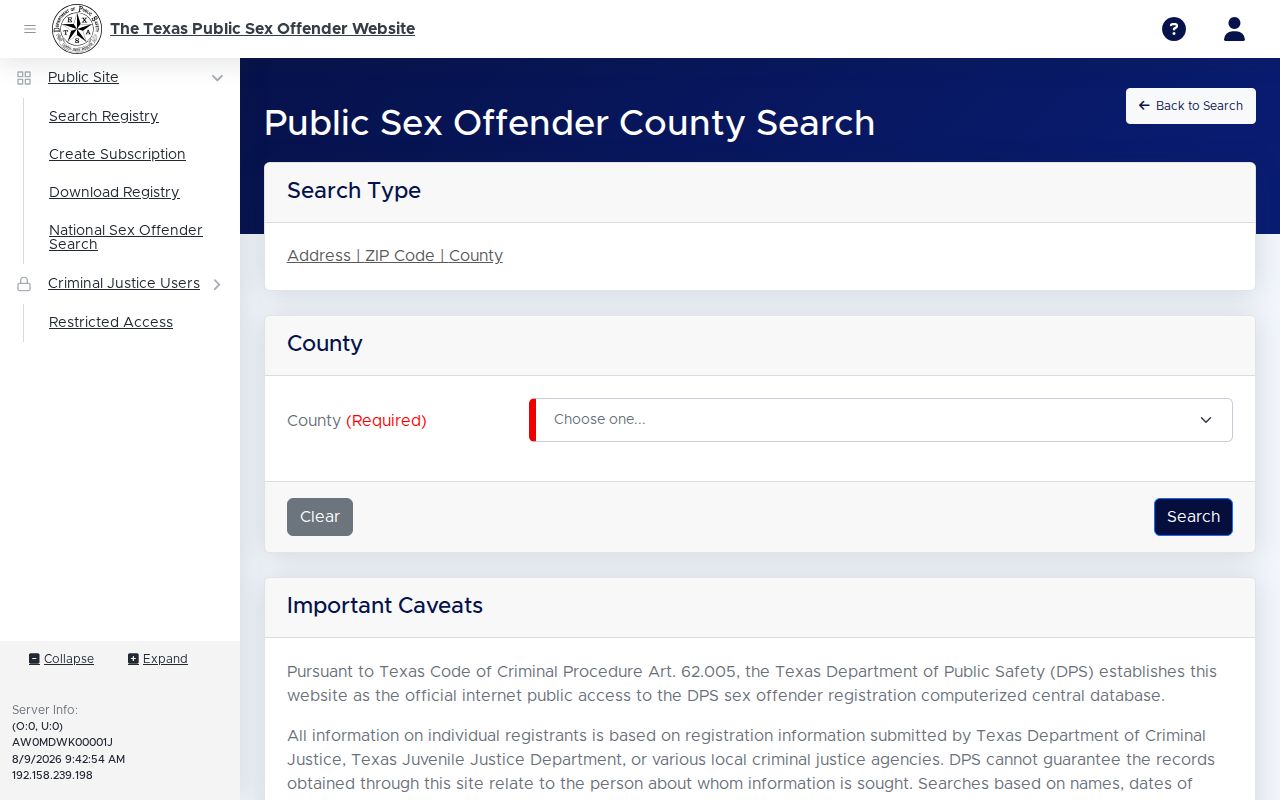
That county-wide view helps include registrations tied to the rural part of Armstrong County, not just its sole incorporated city.
Searching the Texas Public Sex Offender Registry
The Texas registry search presents map-address, registrant-name, and higher-education institution tools. Additional options open dedicated address, ZIP Code, and county forms. Use more than one mode when the address is uncertain, and review unmapped results before concluding that an area has no listed record.
- Open the DPS search and choose the mode that fits the known facts.
- Select Armstrong in county mode, or enter the required street fields in address mode.
- Review mapped and unmapped results, then compare names and dates with care.
- Open the profile and note the verification agency before reporting an error.
| Field or control | Type | Required | Use |
|---|---|---|---|
| Map Address | Geocoder text | Not stated | Returns Texas map results from a place or address. |
| Last / First Name | Text | Not stated | Pairs with Birth Date to narrow possible matches. |
| Birth Date | Date input | Not stated | Helps distinguish similar names, but does not prove identity. |
| County | Select | Mode choice | Choose Armstrong for county-wide coverage. |
| Street fields | Text | Yes | Street Number, Street Name, City, TX, and ZIP Code. |
| Institute / Campus | Dropdowns | Yes in that mode | Searches higher-education affiliations. |
The official search interface shows these separate paths without displaying any private individual in the example.
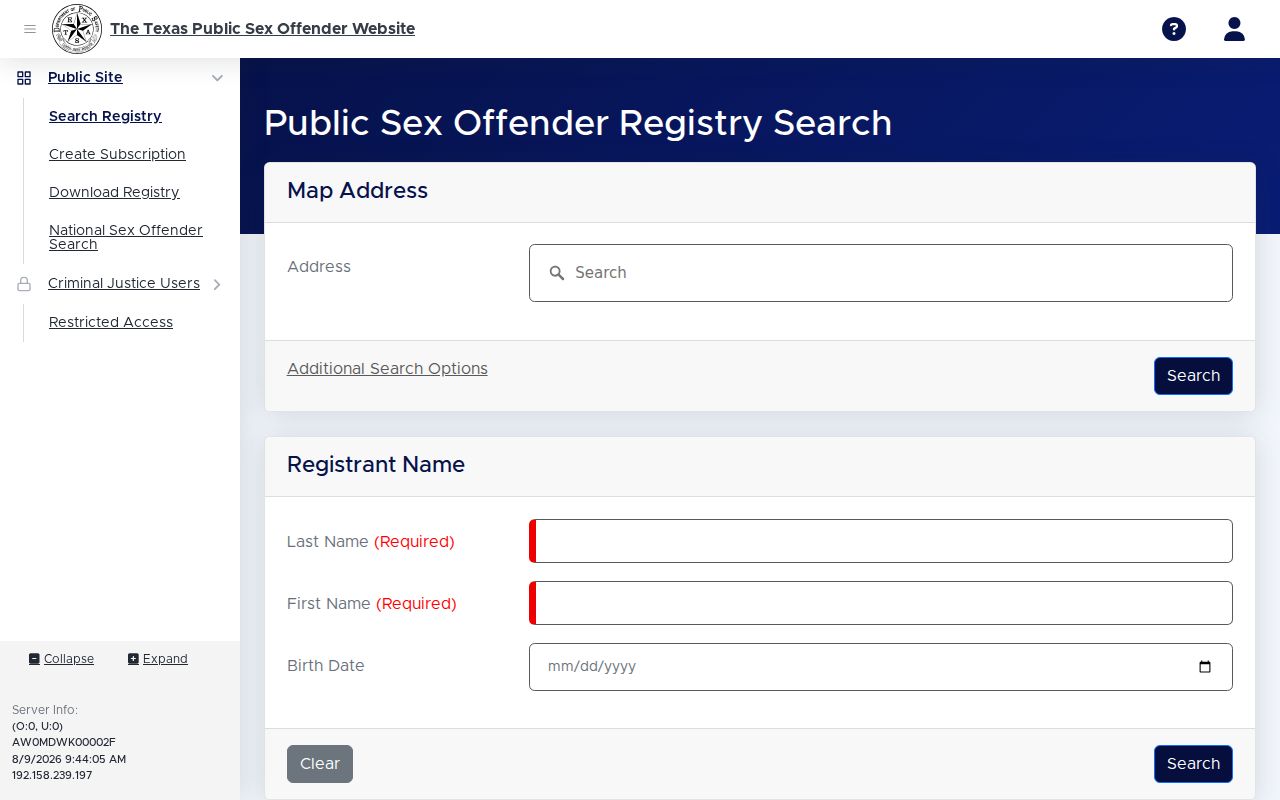
Switching tools is often more reliable than forcing incomplete facts into a single Armstrong County registry query.
Armstrong County Unmapped Registry Results
DPS makes an “Unmapped” category available because mapping software cannot plot every submitted address. Rural routes, local address variations, and incomplete geocoding can place a valid public registration outside the visible pins. A map with few markers is therefore not a complete statement about Armstrong County registry records.
Run the county search alongside the map. Then use the structured address search when the full street information is known. The address form requires street number, street name, city, state, and ZIP Code. If the map and list differ, the list and profile details deserve review. Report a suspected address error to the verification agency shown on that profile, not to an unrelated office.
The address-search image comes from the same DPS system and shows the exact fields used for an Armstrong County location query.
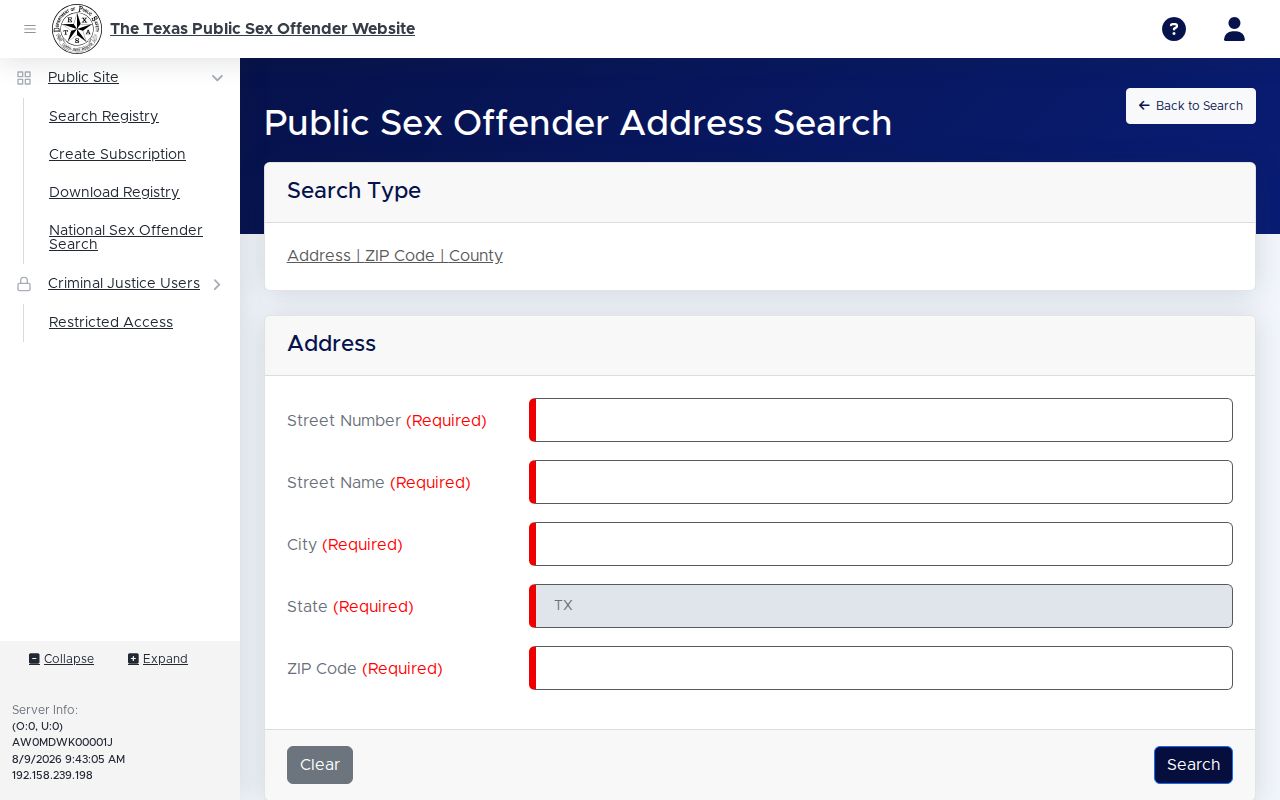
Complete street data can improve the query, but it does not eliminate the need to inspect unmapped Armstrong County results.
What a Registry Profile Shows
A public profile is a fielded registration record, not a full criminal case file. It ordinarily identifies the registrant, reports the qualifying offense and status, gives public residence information, and names the local verification agency. Some information collected during registration remains nonpublic.
| Name and aliases | Full name, aliases, date of birth, sex, and race. |
|---|---|
| Photo and description | A recent image plus height, weight, eye color, hair color, and shoe size. |
| Residence | Home address or a detailed geographic description, with map status when available. |
| Offense | Offense type, victim age, conviction date, and punishment received. |
| Status | Release or supervision status and the agency that verified the registration. |
| Protected fields | Social Security, driver-license and phone numbers, online identifiers, employer details, and victim identity are not public. |
DPS warns that a name, birth date, or other text match does not positively identify a person. Only fingerprints establish that link. Use the verification-agency field when a profile appears wrong. Scar, mark, and tattoo fields were not confirmed in the official material reviewed, so they should not be expected on every result.
Armstrong County Registration Contact
The local registry trail can be less obvious in a county with one small incorporated city and no published municipal police desk. The Armstrong County Sheriff is the documented rural registration authority and the practical contact when DPS shows the sheriff as the verification agency. The office does not advertise a separate registration counter or public local list.
Armstrong County Sheriff
Courthouse, second floor
101 Trice Street
Claude, TX 79019
Mail: P.O. Box 531
Claude, TX 79019
(806) 553-6933
Fax: (806) 553-2998
Call first to confirm the right authority and transaction details. No official source sets a county-specific appointment rule, registry fee, or special desk hours. For an apparent compliance problem, give the displayed verification agency the relevant public profile facts. Use 911 only for an emergency.
Note: A profile error belongs with its listed verification agency; DPS directs users to that agency for correction.
Registration Requirements and Levels in Texas
Texas community-risk levels and federal SORNA tiers answer different questions. Texas assigns risk level 1, 2, or 3 through a screening process. Those numbers help guide community notification. Federal Tier I, II, and III labels describe federal minimum periods and support a Texas early-termination crosswalk. They do not set a simple public-visibility ladder for Armstrong County profiles.
| Federal tier | Federal minimum | Texas duty |
|---|---|---|
| Tier I | 15 years | Texas may require a post-10 period or lifetime, based on the offense. |
| Tier II | 25 years | Many crosswalk offenses still carry lifetime Texas registration. |
| Tier III | Lifetime | Many serious Texas offenses also require lifetime registration. |
Under Code of Criminal Procedure Chapter 62, a non-lifetime “post-10” duty ends ten years after the latest controlling event, such as release, discharge from supervision, or dismissal of proceedings. It does not always run from conviction. Verification frequency is separate: most registrants verify yearly, specified repeat sexually violent cases verify at least every 90 days, and a person without a fixed address confirms location at least every 30 days.
Armstrong County Registry Change Alerts
After the first Armstrong County search, residents can use the DPS email subscription service to track database changes. Unlike an ordinary public search, the alert service requires an account. Its sign-in screen asks for an email address or user ID and password and includes account creation and password-reset links.
The official subscription entry illustrates that separate account step.
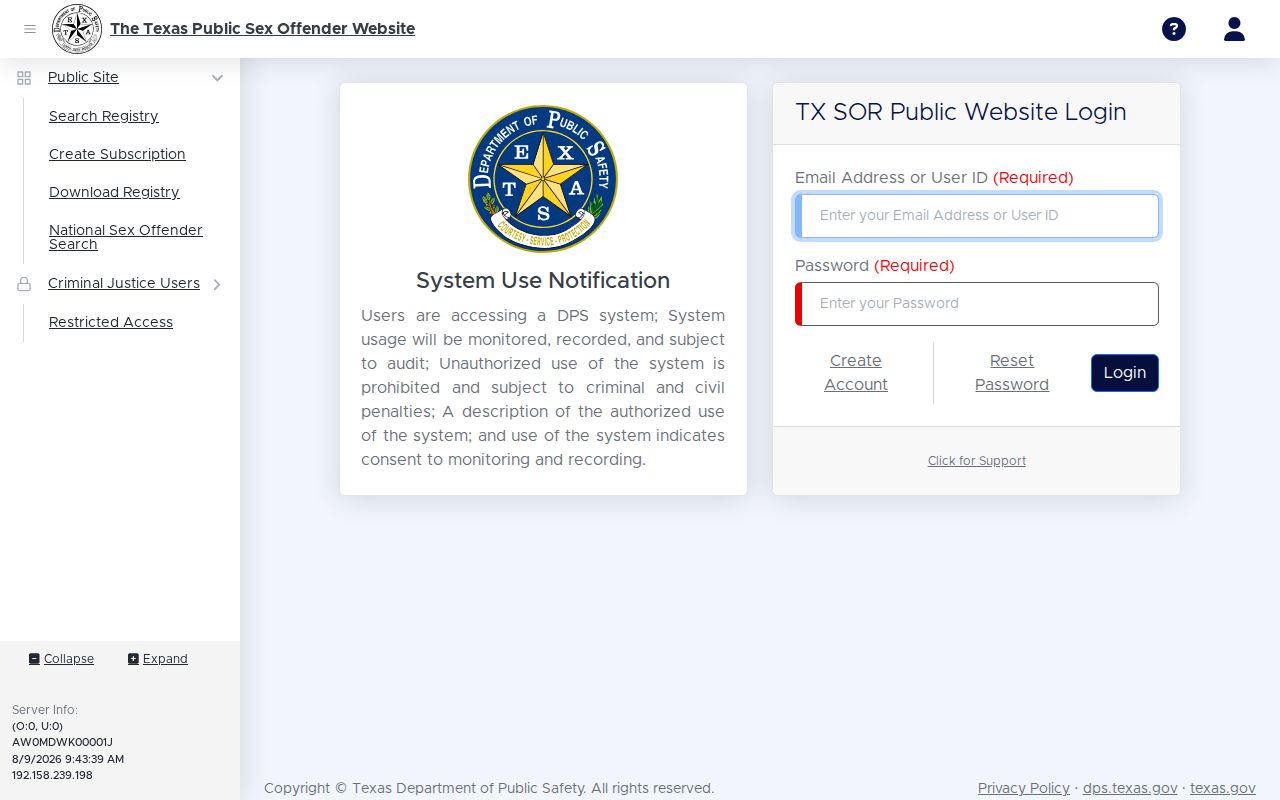
Alerts supplement a fresh search. They should not replace checking current Armstrong County results when a safety decision depends on current data.
DPS lists public-site account support on weekdays from 8 a.m. to 5 p.m. and technical support at (855) 481-7070. The Texas DPS mobile application also offers a registry map with location, name, route, and proximity functions. No Armstrong County sheriff app was found.
Beyond Armstrong County Registry Records
Use the National Sex Offender Public Website when a person or address may cross state lines. NSOPW searches participating public registries through a federal interface. It is the stronger second layer for a move from another state, travel near a border, or a name whose recent location is not known. Texas DPS also links to it from the registry landing page.
For an Armstrong County address, begin with Texas county, address, and unmapped results because they expose Texas-specific profile and verification information. Move to NSOPW for the wider geographic check. Neither service replaces fingerprint identification, and neither should be read as a complete criminal history. The registry includes only public information for people subject to registration rules.
Lawful Use and Community Notification
The registry supports community awareness and personal safety planning. Texas authorities may also provide postcard notice when a high-risk registrant or civilly committed sexually violent predator moves into a community. Local authorities maintain registration details, notify schools when required, and send data to DPS. The registry landing page explains the system’s caveats, alert and national-search routes.
The DPS registry notice is the source for those limits and warnings.
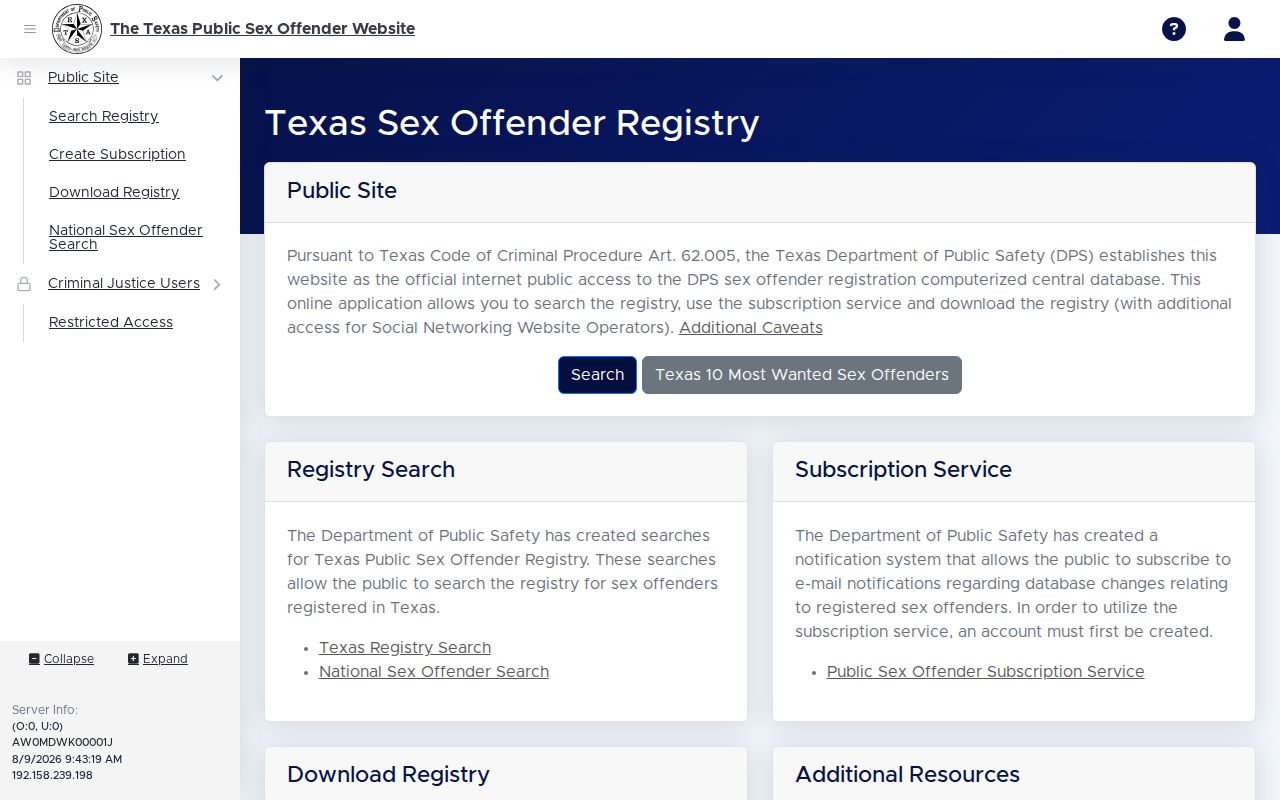
Those warnings matter because public access does not grant permission to harm, threaten, or harass anyone listed.
Use registry information lawfully: The Texas DPS portal warns that using registry information to injure, harass, or commit another unlawful act can bring criminal prosecution or civil liability under Texas law.
Not everyone subject to Chapter 62 appears publicly. Statutes and judicial orders can keep some registration information nonpublic. Treat search results as public safety information, confirm disputed details with the profile’s verification agency, and do not use the data for vigilantism or discrimination.